Outset vs Strella: A Full Feature Comparison (2026)
Jun 3, 2026
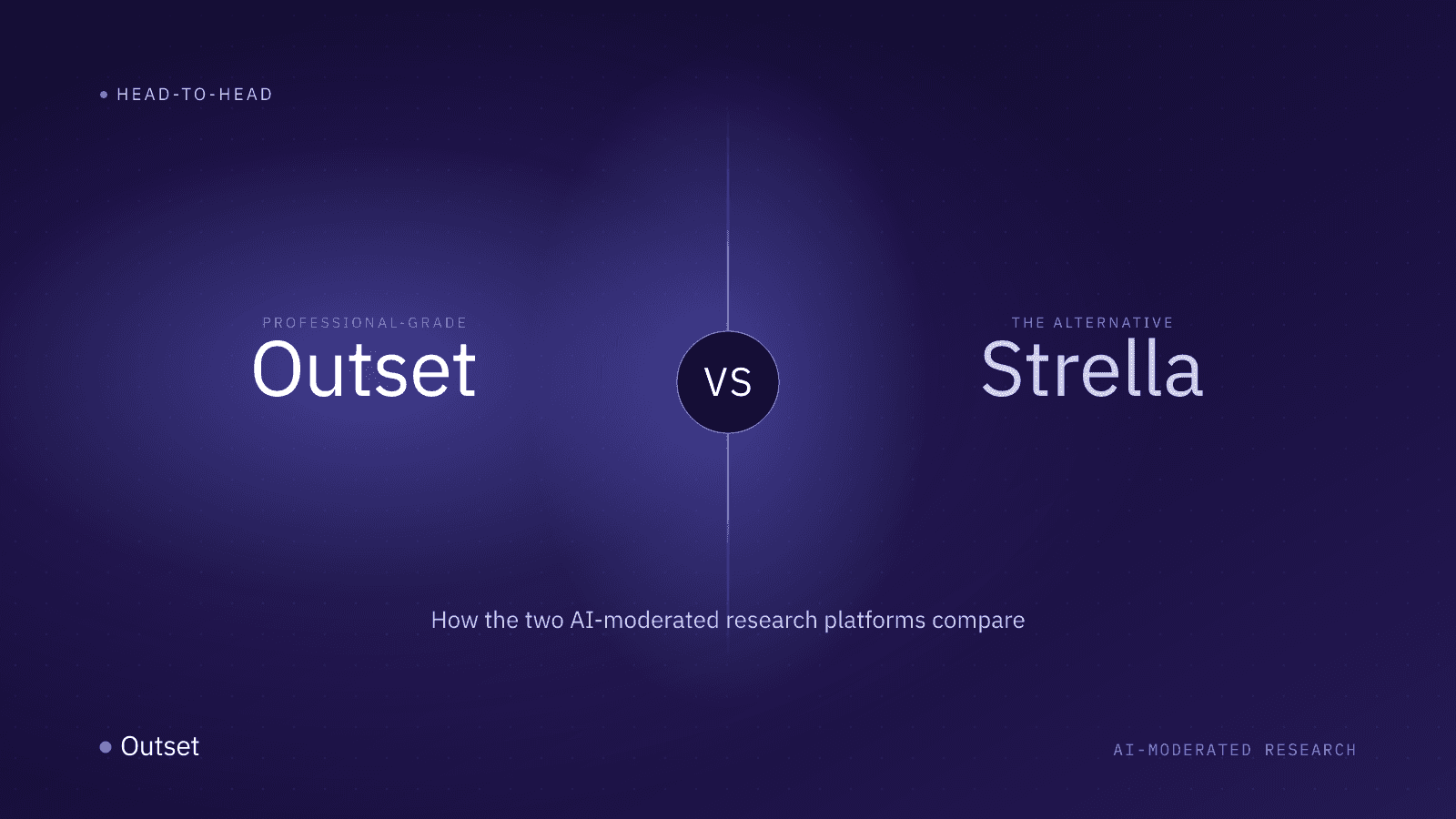
Outset vs Strella: A Full Feature Comparison for 2026
The market for AI-moderated research tools has exploded—over 15 platforms now claim to automate qualitative interviews. But when you're evaluating Outset vs Strella specifically, the differences that matter aren't on the feature checklist. They're in how each platform handles the complexity of real research programs.
This comparison of Outset vs Strella breaks down both platforms across the dimensions that actually determine success: moderation depth, methodology breadth, Visual Intelligence, enterprise governance, and the human support that keeps research programs running.
Key takeaways
Outset is built for research programs, Strella for rapid synthesis: Outset handles ongoing, multi-methodology research at enterprise scale, while Strella focuses on quick thematic analysis for simpler studies.
Visual Intelligence is Outset's exclusive capability: Outset's AI moderator can see screens, prototypes, packaging, and facial reactions in real time—Strella doesn't offer this.
Methodology breadth sets Outset apart: IDIs, surveys, concept testing, usability studies, shopalongs, IHUTs, and diary studies all run in one platform.
Enterprise governance matters at scale: Outset provides SOC 2 Type II, GDPR, and HIPAA compliance with multi-layer access controls and data-segregated workspaces.
Human partnership closes the gap: Outset pairs technology with forward-deployed research experts who design studies, build integrations, and drive adoption.
What is Outset
Outset is a professional-grade AI-moderated research platform designed for teams running ongoing research programs rather than one-off studies. The platform combines conversational AI with behavioral intelligence and visual analysis to deliver qualitative depth at survey-like speed.
Four pillars define how Outset works:
Researcher Configurability: you control the moderator style, probing depth, and analysis frameworks)
Breadth of Capability: IDIs, surveys, concept testing, usability, diary studies, shopalongs, and more in one place
Enterprise Infrastructure: integrations, governance, and compliance for organizations of any size
Human Partnership: forward-deployed researchers and dedicated support partners
Teams at Microsoft, HubSpot, Nestlé, Google, Ipsos, and WeightWatchers run their research programs on Outset.
What is Strella
Strella is an AI-powered research platform that emphasizes real-time synthesis and rapid theme generation from qualitative data. The platform targets teams looking to move quickly from interviews to initial insights.
Strella works well for teams prioritizing speed on simpler studies or organizations without complex governance requirements. It's a capable tool with a different focus than Outset—less about methodology breadth and enterprise infrastructure, more about fast turnaround on thematic analysis.
Outset vs Strella at a glance
Feature | Outset | Strella |
|---|---|---|
AI-moderated interviews | Adaptive conversations with layered probing (Abyss mode) and instant synthesis | AI-moderated interviews with real-time synthesis |
Visual Intelligence | AI sees screens, prototypes, packaging, facial reactions | Not available |
Methodology breadth | IDIs, surveys, concept testing, usability, shopalongs, IHUTs, diary studies | Primarily IDIs and surveys |
Enterprise governance | SOC 2 Type II, GDPR, HIPAA, multi-layer access controls | Standard security measures |
Human partnership | Forward-deployed research experts | Self-serve with support |
Recruitment | 1.1B+ participants, 85+ countries, native panel integrations | Panel integrations available |
Languages | 40+ languages | Multilingual support |
Outset vs Strella on AI-moderated interviews
When researching Outset vs Strella, you'll immediately find that both offer AI-moderated interviews that use conversational AI to conduct research conversations at scale, compressing timelines from weeks to days. Instead of a human moderator, an AI interviewer asks questions, listens to responses, and follows up dynamically—much like a skilled researcher would, but across hundreds of sessions at once.
While they both offer this capability, the differences show up in how deep the conversations go and how much control researchers keep over the instrument.
Conversational depth and probing
Outset's Abyss mode allows up to ten layered follow-ups per question, letting the AI dig deeper when participants give surface-level answers. You set the probing depth and moderator style; the AI executes your methodology, not its own.
Strella's approach emphasizes speed to synthesis, which can mean less granular control over how aggressively the moderator probes. For studies where depth matters more than speed, this distinction becomes significant.
Adaptive follow-up logic
Outset's AI clarifies context in real time and adapts to participant tone and phrasing. The researcher defines the guide logic—skip patterns, conditional branches, probing triggers—and the AI follows that structure while responding naturally to what participants actually say.
Real conversations don't follow scripts. Participants go off-topic, give ambiguous answers, or reveal unexpected insights. An AI that adapts while staying within your methodology captures those moments without losing rigor.
Quant and qual in a single study
Outset runs Likert scales, matrix questions, and ranking exercises alongside conversational probing in one study. You don't need separate tools for your quantitative and qualitative research—they happen in the same session, with the AI probing on the "why" behind each rating.
When a participant rates something a 3 out of 5, the AI can immediately ask what would make it a 5.
Outset vs Strella on synthesis and reporting
Both platforms offer AI-driven synthesis, but the depth and flexibility differ. Outset generates executive-ready reports, thematic summaries, and highlight reels instantly—all aligned to your research objectives. The synthesis links back to raw moments and quotes, so stakeholders can trace any insight to its source.
Instant top-line reports: Auto-generated summaries organized around your research questions
Chat With Your Data: Query insights across multiple studies conversationally, like asking a research assistant
Highlight reels: Stakeholder-ready video clips that tell the story without requiring anyone to watch hours of footage
Strella emphasizes real-time synthesis during and immediately after sessions. For teams focused primarily on speed to initial themes, that works well. For teams who want to query across studies or build institutional knowledge over time, Outset's approach offers more flexibility.
Outset vs Strella on participant recruitment
Outset connects to 25+ global panels—including Prolific, User Interviews, Respondent, and Dynata—giving access to over 1.1 billion B2B and B2C participants across 85+ countries. You can also invite your own users via shareable links or pre-test guides with AI-generated synthetic users.
AI-powered fraud detection monitors sessions and filters low-quality or fraudulent responses with 99%+ accuracy. You only pay for authentic data.
Strella offers panel integrations as well, though with a narrower range of native connections. For teams recruiting niche B2B audiences or running global studies, the breadth of Outset's recruitment network becomes a meaningful advantage.
Outset vs Strella on methodology breadth
Outset runs IDIs, surveys, concept testing, usability studies, shopalongs, IHUTs, and diary studies in one platform. This breadth matters for teams running research programs rather than isolated projects—you don't switch tools or learn new interfaces when your research questions change.
In-depth interviews and surveys
Both study types run in the same workflow. You can start with a survey to establish quantitative baselines, then follow up with AI-moderated IDIs to explore the patterns you find—all without exporting data or switching platforms.
Concept testing and usability studies
Outset supports screensharing and picture-in-picture for prototype testing. More importantly, Visual Intelligence lets the AI moderator see what participants see—click paths, interface interactions, moments of confusion—and probe on those observations in real time.
Shopalongs, IHUTs, and diary studies
In-home use tests, shopalongs, and diary studies are rare in AI-moderated platforms. Outset handles all three: participants can show products on camera, navigate real or virtual retail environments, and complete diary entries over days or weeks. If your research program spans multiple methodologies, this breadth eliminates the need for point solutions.
Outset vs Strella on Visual Intelligence
Visual Intelligence means the AI moderator can see and respond to visual information during sessions—screens, prototypes, packaging, retail shelves, and facial reactions.
Nielsen Norman Group noted that most AI tools cannot properly watch usability tests—Outset is first-to-market with this capability and offers the most robust implementation available. The AI doesn't just record video; it analyzes what it sees and incorporates those observations into follow-up questions.
Screen and prototype analysis: Outset's Digital Intelligence tracks click paths and interface interactions, probing on moments of hesitation or confusion
Packaging and shelf testing: Outset's Physical Intelligence lets participants show products or navigate retail environments while the AI probes on what they notice
Facial reaction capture: Outset's Emotional Intelligence supplements verbal feedback with facial and sentiment data, revealing reactions participants might not articulate
Strella does not currently offer Visual Intelligence. For usability testing, concept testing, or any research where seeing matters as much as hearing, this gap is significant.
Outset vs Strella on enterprise infrastructure and governance
With 88% of organizations now using AI regularly, large organizations have requirements that go beyond running good studies. Security certifications, integration capabilities, and governance models that work across distributed teams all matter.
Security and compliance
Outset is SOC 2 Type II, GDPR, and HIPAA compliant, running on enterprise-grade Azure infrastructure. For teams in healthcare, financial services, or any regulated industry, these certifications are table stakes for vendor approval.
Integrations and workspaces
Outset offers data-segregated workspaces, white-labeling for agencies, and integrations that connect to existing research operations infrastructure. Your data stays organized, your brand stays consistent, and your workflows stay connected.
Multi-layer governance and democratization
Scaling research access across an organization creates tension: you want more people running studies, but you also want controls to maintain quality and compliance. Outset's multi-layer governance lets you democratize research while maintaining oversight—different permission levels, approval workflows, and visibility controls for different roles.
Outset vs Strella on human partnership and support
Outset pairs technology with forward-deployed research experts. These aren't support agents reading scripts—they're experienced researchers who help design studies, build integrations, and drive adoption across your organization.
Study design support: Research experts help configure complex studies, ensuring your methodology translates correctly to the platform
Integration assistance: Engineering support for connecting Outset to your existing systems and workflows
Adoption enablement: Partnership to scale research access across teams, including training and change management
Strella operates primarily as a self-serve platform with standard support. For teams with deep research expertise who prefer to work independently, that works fine. For teams building research programs at scale, human partnership accelerates time-to-value and reduces the risk of methodological missteps.
Outset vs Strella on pricing
Pricing is one of the most common questions in platform evaluations, and the models differ meaningfully.
Outset uses enterprise pricing, typically structured around seats plus usage for larger studies. This model works well for teams running ongoing programs where predictable costs matter. The exact pricing depends on team size, study volume, and program scope—contact Outset's team for a custom quote.
Strella positions itself with flexible seat-based pricing designed to scale more accessibly. For smaller teams or organizations running occasional studies, this may feel more approachable initially.
The real question isn't which model costs less—it's which platform delivers more value for your research program.
When to choose Outset over Strella
Outset is the stronger choice when you're running ongoing research programs rather than isolated studies, when you want multiple methodologies in one platform, when Visual Intelligence matters for your research, when you operate at enterprise scale with governance and compliance requirements, or when you want human partnership rather than just a help desk.
When Strella might be the right fit
Strella may suit teams focused primarily on rapid thematic synthesis for simpler studies, smaller-scale projects without complex governance requirements, or organizations that prefer a fully self-serve model.
How to choose between Outset and Strella
1. Define the scope of your research program
Are you running isolated studies or an ongoing research program? Programs require configurability, governance, and the ability to query across studies over time.
2. Audit your methodology mix
What study types do you run or plan to run? If your list extends beyond IDIs and surveys—usability testing, concept testing, diary studies, shopalongs—methodology breadth becomes a deciding factor.
3. Validate enterprise and governance requirements
Does your organization require SOC 2, GDPR, or HIPAA compliance? Do you want multi-layer access controls, data segregation, or integration with existing systems?
4. Pressure-test moderation and synthesis depth
How deep do your interviews go? Running a pilot with both platforms on the same study lets you compare the quality of probing, the richness of synthesis, and the usability of the outputs.
Key takeaways
Outset is built for research programs, Strella for rapid synthesis: Outset handles ongoing, multi-methodology research at enterprise scale, while Strella focuses on quick thematic analysis for simpler studies.
Visual Intelligence is Outset's exclusive capability: Outset's AI moderator can see screens, prototypes, packaging, and facial reactions in real time—Strella doesn't offer this.
Methodology breadth sets Outset apart: IDIs, surveys, concept testing, usability studies, shopalongs, IHUTs, and diary studies all run in one platform.
Enterprise governance matters at scale: Outset provides SOC 2 Type II, GDPR, and HIPAA compliance with multi-layer access controls and data-segregated workspaces.
Human partnership closes the gap: Outset pairs technology with forward-deployed research experts who design studies, build integrations, and drive adoption.
Deeper conversations yield richer insights: Outset's Abyss mode enables up to ten layered follow-ups per question, giving researchers granular control over probing depth that Strella's speed-focused approach doesn't match.
Global reach with quality controls: Access to 1.1B+ participants across 85+ countries through 25+ panel integrations, backed by AI-powered fraud detection that ensures 99%+ data authenticity.
Synthesis that scales with your program: Query insights across multiple studies conversationally, generate executive-ready reports instantly, and create stakeholder-ready highlight reels—all while maintaining traceability to source moments.
Choose Outset when research is strategic, not tactical: If you're building institutional knowledge, running diverse methodologies, operating under compliance requirements, or scaling research access across teams, Outset delivers the infrastructure and partnership that research programs demand.
The professional-grade choice for AI-moderated research
Most AI-moderated tools were built for the demo—clean, fast, shallow. Outset was built for the job: the rigor, scale, and complexity that real research programs demand.
If you're evaluating platforms for a serious research program, book a demo to see how Outset handles your specific requirements.
Frequently asked questions about Outset vs Strella
How much does Outset cost?
Outset offers enterprise pricing based on team size and program scope. The model typically includes seat costs plus usage layers for larger studies. Contact the sales team for a custom quote tailored to your organization's research volume and requirements.
Does Outset offer a free trial?
Outset provides guided pilots and demos rather than ungated free trials. This approach ensures teams experience the platform with expert support on real research questions.
Can Outset replace Strella for ongoing research programs?
Yes. Outset is purpose-built for ongoing programs with the methodology breadth, governance, and human partnership that research teams want at scale.
How does Outset handle data security and compliance?
Outset is SOC 2 Type II, GDPR, and HIPAA compliant, with enterprise-grade infrastructure on Azure. AI-powered fraud detection monitors sessions and filters low-quality responses with 99%+ accuracy.
What languages do Outset and Strella support?
Outset supports AI-moderated interviews in over 40 languages with native multilingual synthesis. Check Strella's documentation for their current language coverage.
Book a demo to see how Outset handles your research methodology.