What is mobile ethnography? A practical guide for research teams
Jun 3, 2026

What is mobile ethnography?
Mobile ethnography is a qualitative research method where participants document their own behavior and experiences in their natural environment using their smartphones. Instead of a researcher observing in person, participants capture photos, video, screen recordings, and short written entries as moments happen.
Ethnography means studying people in their real-world context. "In-context" research captures what people actually do in a kitchen, a store, or in front of a screen — not what they recall later in a focus group.
The difference matters because memory is unreliable. A 2022 study reported by Digiday found that 38% misremember their behavior when asked to recall it after the fact. Mobile ethnography closes that gap by recording behavior in the moment, before it is forgotten.
Why mobile ethnography matters now
Mobile ethnography is practical today because nearly everyone carries a capable smartphone. According to Pew Research Center, 98% of Americans own a cellphone of some kind and 91% own a smartphone — up from just 35% in 2011.
That reach extends across age groups. Data from Pew shows that ownership spans every age group: 97% of adults under 50 and 90% of those ages 50 to 64 have a smartphone, and 78% of adults 65 and older still do.
The global picture is just as strong. There are 5.78 billion mobile users worldwide, equaling 70.5% of the world's population. People now spend an average of 3 hours and 46 minutes a day on mobile, compared to 2 hours and 52 minutes on computers.
This is why the global insights industry — estimated at over US$150 billion and expected to surpass US$160 billion in 2025 — is investing in technology-enabled methods. The device people already carry is now a research instrument.
How mobile ethnography works
A mobile ethnography study follows a straightforward flow. You define what you want to learn, recruit the right participants, capture behavior in context, probe for deeper understanding, and analyze what you find.
The sections below walk through each step.
Step 1: Define objectives and design tasks
Start by deciding the behavior you want to observe. Are you tracking how people shop for snacks, how they set up a new product at home, or how they navigate an app?
Design short tasks participants complete in the moment — record a video of a decision, snap a photo of a shelf, or narrate why they chose one option over another. Tasks should be specific enough to yield useful data but open enough to surface unexpected behavior.
Step 2: Recruit and onboard participants
Recruit participants who actually do the behavior you want to study. If you are researching morning routines, recruit people whose mornings vary by household size, schedule, and geography.
Onboard participants so they know what to capture, when to capture it, and how to submit. Clear instructions reduce drop-off and improve data quality. Outset supports studies in 40+ languages, so you can run multi-market research without separate tools.
Step 3: Capture in-context data
Participants self-document over hours, days, or weeks. They record video in their kitchen, snap photos at the shelf, or screen-record how they use an app.
This multimedia capture records the environment, not just words. It also removes the "researcher effect" — people behave differently when an observer is standing next to them. With mobile ethnography, participants capture real-world behavioral research as it happens, which is how you close the say-do gap.
Step 4: Add live probing and moderation
Traditional mobile ethnography leaves follow-ups as delayed, async messages. A participant submits a vague entry; hours later, a researcher sends a clarifying question; hours after that, the participant responds — if they remember the context at all.
AI moderation changes this. With AI-moderated interviews, the platform holds a real conversation and probes vague answers in the moment. If a participant says "I just picked the usual one," the AI asks what made it usual. This happens during the session, not after — delivering the same depth as an in-depth interview at every round.
Step 5: Analyze and synthesize
Turn photos, video, and text into themes, quotes, and highlights. The goal is to extract patterns across participants without losing the rich, specific moments that make ethnography valuable.
With context-aware AI moderation, synthesis can start at the first submission rather than wait until the end. The AI can see and interpret visual cues — facial expressions, packaging, shelf arrangements — not just transcribe words.
Benefits of mobile ethnography
Key point: Authenticity — Participants capture behavior in their natural environment, reducing the observer effect that distorts lab studies and focus groups.
Key point: Cost-effectiveness — No travel, no on-site logistics, no per-session researcher time. You fund insight, not airfare.
Key point: Speed — Run concurrent sessions across dozens or hundreds of participants instead of scheduling one-on-one visits sequentially.
Key point: Scale and reach — Recruit across markets, languages, and time zones with devices participants already own.
Key point: Richer data — Multimedia captures context that surveys and interviews miss: the cluttered counter, the hesitation before a click, the shelf at eye level.
Common use cases and examples
Mobile ethnography applies wherever you need to understand behavior in context. Common examples include:
Diary studies — Track habits, routines, or attitude changes over days or weeks.
Path-to-purchase and shopper research — Follow a buying journey from first consideration to checkout.
Customer journey mapping — Document touchpoints and friction across a full experience.
In-home usage testing — Watch how people actually use a product in their kitchen, bathroom, or living room.
UX and product research — Capture screen recordings and narrated walkthroughs of app or site usage.
Healthcare and patient experience — Understand daily routines, treatment adherence, and care decisions in real life.
For example, luggage brand Away wanted to understand shopper behavior at scale. See how Away scaled research — they conducted 75 interviews overnight with a team of one and surfaced surprising behavior from 98% of shoppers.
Mobile ethnography vs. traditional ethnography
Both methods aim to understand behavior in context. The difference is who captures the data and where the researcher sits.
Dimension | Traditional ethnography | Mobile ethnography |
|---|---|---|
Who captures data | Researcher observes directly | Participant self-documents |
Researcher presence | Physically present | Remote |
Cost per participant | High (travel, time on site) | Lower (no travel, concurrent sessions) |
Scale | Limited by researcher availability | Can run hundreds of participants in parallel |
Setting | Wherever the researcher can go | Wherever the participant is |
Traditional ethnography gives you deep, unstructured observation. Mobile ethnography trades some of that depth for reach, cost efficiency, and reduced observer effect.
How mobile ethnography relates to diary studies
Mobile ethnography and diary studies overlap, but they emphasize different things.
Diary studies focus on change over time — participants log entries across multiple rounds over days or weeks. Mobile ethnography emphasizes in-context, spatial capture — what the environment looks like, what the participant does in that moment.
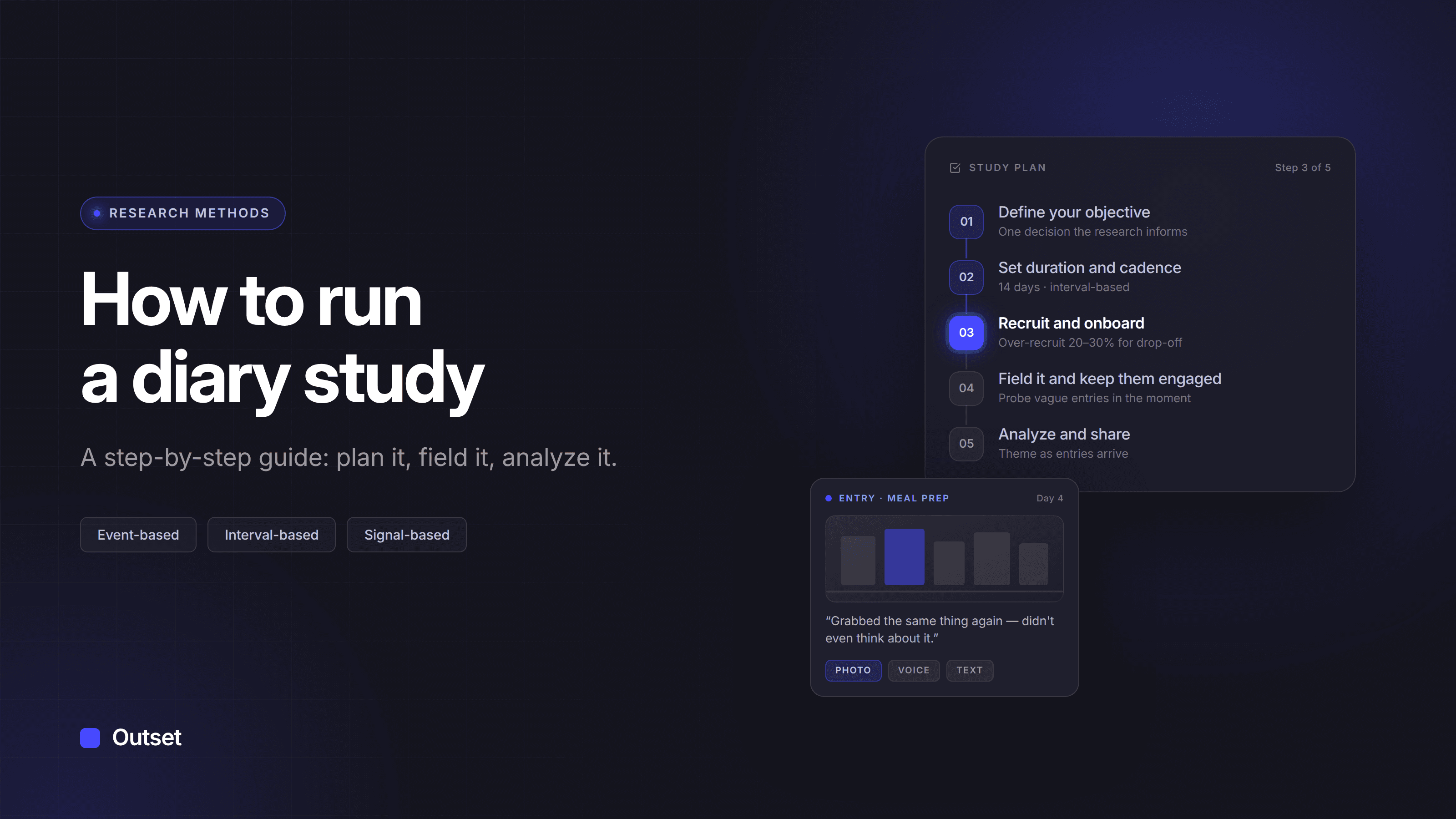
In practice, the two often run together. A study might ask participants to capture their morning routine on day one, then log how it changes over a week. Outset supports diary studies with live AI moderation each round, so every session is a real conversation — not just a form submission.
Who uses mobile ethnography
UX researchers use mobile ethnography to watch how people use products and apps in their real environment, not a lab. They capture screen recordings, narrated walkthroughs, and reactions that usability tests in controlled settings miss.
Market researchers use it to follow the customer journey across touchpoints — from awareness to purchase to use. They surface moments of friction, delight, and decision that surveys cannot reach.
Consumer insights teams at CPG and retail brands use mobile ethnography to understand in-home usage, shopper behavior, and unboxing experiences. For teams balancing strategic depth with high research demand, mobile ethnography delivers ethnographic richness without ethnographic timelines.
How to choose a mobile ethnography tool
When evaluating platforms, ask:
Does it capture rich multimedia in context? Look for video, photo, screen recording, and audio — not just text forms.
Can it moderate and probe, not just collect? The difference between a form and a conversation is follow-up. Can the platform ask clarifying questions in the moment?
Does it synthesize automatically? Manual tagging and theme coding take weeks. Look for built-in analysis that starts at the first submission.
Does it support your languages and markets? Global research requires multi-language support and broad participant reach.
Does it meet enterprise security and governance needs? Look for SOC 2 Type II, GDPR, and HIPAA compliance, plus the access controls your organization requires.
Outset meets these criteria. The platform runs AI-moderated in-context research across 85+ countries and 40+ languages, with instant synthesis and enterprise-grade security.
Frequently asked questions
What is the difference between mobile ethnography and traditional ethnography?
Both aim to understand behavior in context. Traditional ethnography requires a researcher to be physically present, while mobile ethnography has participants self-document remotely — cutting cost and removing the observer effect.
What is the difference between mobile ethnography and a diary study?
Mobile ethnography emphasizes spatial and environmental context — what the setting looks like, what happens in the moment. Diary studies emphasize change over time across multiple rounds. The two often overlap and can run together.
How many participants do you need for a mobile ethnography study?
A focused study often runs 15 to 30 participants, while larger programs run into the hundreds across markets. You usually need fewer participants than a survey because each person yields rich data over time.
How long does a mobile ethnography study take?
Field time ranges from a few days to a few weeks, depending on scope. A narrow, single-behavior study can close in three to five days; a multi-week diary study takes longer by design.
What devices do participants need?
A smartphone with a camera and a reasonable internet connection. Since most people already carry one, recruitment is straightforward.
Can mobile ethnography replace focus groups?
Mobile ethnography can stand alone or complement focus groups and interviews. Many teams use it as pre-work that gives moderators richer material to explore in live sessions.