UX & Usability
Prototype Testing in Outset Just Got More Powerful
—

Aaron Cannon

Prototype testing has always had a ceiling.
You could watch what participants did — click paths, time on task, completion rates. You could ask what they thought, through post-session surveys or follow-up interviews. But the moment itself, the hesitation before a wrong turn, the rage click on a field that won't respond, the scroll-and-backtrack before someone loses the thread — that moment existed in a gap between the behavioral tool and the question.
Our release of Digital Intelligence closed that gap. The AI observes screen behavior during a session and probes based on what it actually saw, while the participant is still in the moment. No video review queue. No reconstructing what happened from a recording.
And the Figma integration adds the second layer.
Figma Prototypes, Native in Outset
Figma prototypes now load directly inside an Outset study. Participants click a link, the prototype opens in the session, and the interview begins. No redirect to a separate tool. No screen share setup. No friction that filters out lower-tech-comfort participants before the research starts.
The native environment matters because it's what makes both layers possible.
Layer One: Digital Intelligence Observes in Real Time
Visual Intelligence is the suite that gives Outset's AI moderator eyes during a session. Digital Intelligence, the capability within that suite that watches screen and prototype interactions, is active across all task questions. For Figma prototype testing, that means every interaction inside the design is observed as it happens.
What Digital Intelligence tracks:
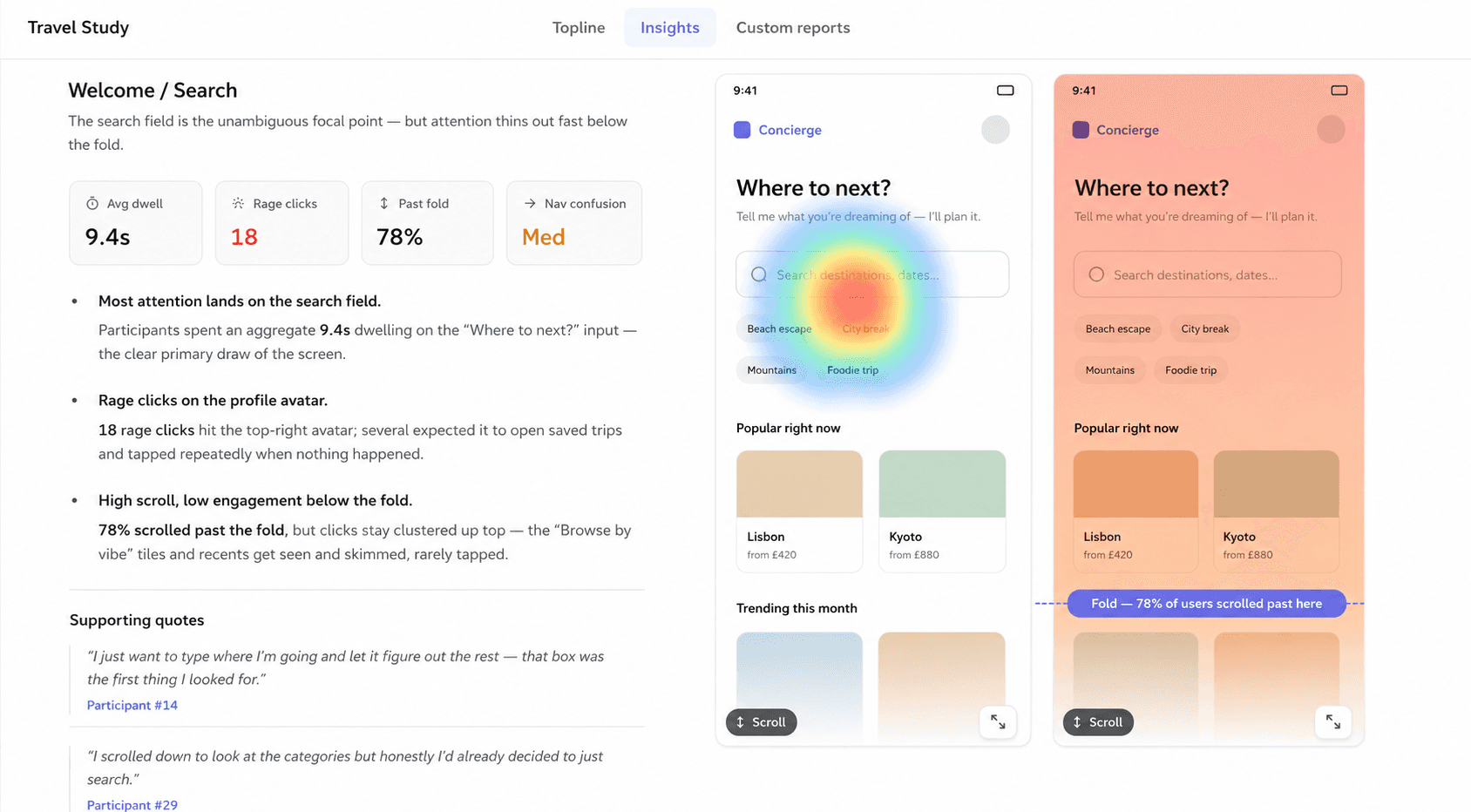
Clickmap: Where participants click across the prototype, including taps on elements they expected to respond
Scrollmap: How far participants scroll before engaging with a section or moving on
Rageclicks: Repeated taps on an element that isn't responding the way participants expected
Navigation confusion: Backtracking and hesitation patterns before someone loses the thread
The AI moderator probes based on what it sees, while the participant is still inside the experience. Not a pre-written question. A probe about that specific moment, before the participant has had time to rationalize it away.
Layer Two: Figma Analytics Flow Into Synthesis
When the study closes, Figma's analytics data flows into Outset's synthesis, to enhance the digital observations that Outset reports on. This is separate from what Digital Intelligence observed in real time — and additive to it. Granular interaction data on how participants moved through the design feeds directly into the same report where qualitative responses live.
Most prototype testing tools produce one of these outputs. Some produce two. Outset produces all three in a single synthesis: what participants did inside the design, what the AI observed and probed during the session, and what participants said in response.
No stitching between tools. No manual video review. No cross-referencing a separate analytics report against a transcript. The behavioral record, the conversational depth, and the interaction analytics arrive together.
What This Means for Design Research
Concept tests, prototype walkthroughs, usability evaluations — all of this now runs in Outset, with the same AI moderation and synthesis format as every other study you run on the platform.
For research teams already using Outset, the Figma integration closes the last gap in the research lifecycle. The design phase has had its own toolset because it had to. That's no longer true.
For teams evaluating where prototype testing lives, the question is no longer whether to use a dedicated usability tool or a general research platform. Outset covers both — with an output that neither produces alone.
No other platform observes what participants do inside a Figma prototype in real time, probes based on what it sees, and enhances synthesis with Figma's post-study analytics data. That combination is what closes the say-do gap in design research.
Interested in learning more? Book a personalized demo today!
Book Demo
About the author
Aaron Cannon
CEO - Outset
Aaron is the co-founder and CEO of Outset, where he’s leading the development of the world’s first agent-led research platform powered by AI-moderated interviews. He brings over a decade of experience in product strategy and leadership from roles at Tesla, Triplebyte, and Deloitte, with a passion for building tools that bridge design, business, and user research. Aaron studied economics and entrepreneurial leadership at Tufts University and continues to mentor young innovators.