AI Moderated Interviews: A Practical Research Guide
Jun 3, 2026
AI Moderated Interviews: A Practical Guide for Research Teams
AI moderated interviews are automated, conversational research sessions where an AI agent conducts one-on-one interviews with participants—asking questions, probing for deeper context, and synthesizing responses in real time. They combine the depth of traditional qualitative research with the speed and scale of a survey.
This guide covers how AI moderated interviews work, when to use them (and when not to), how to write discussion guides that get better data, and what separates professional-grade platforms from tools built for the demo.
Key takeaways
AI moderated interviews combine qualitative depth with survey-scale reach. Teams run hundreds of in-depth conversations simultaneously, each with dynamic follow-ups and probing.
The researcher stays in control. Professional-grade platforms let you configure moderator style, probing depth, guide logic, and analysis frameworks. The AI is your instrument, not your replacement.
Visual Intelligence closes the say-do gap. Outset is first-to-market with the ability for the AI moderator to see screens, prototypes, packaging, and facial reactions—then probe on what it observes.
Enterprise infrastructure matters for ongoing programs. Multi-layer governance, data-segregated workspaces, and native integrations separate platforms built for the job from platforms built for the demo.
What are AI moderated interviews
AI moderated interviews are automated, conversational research sessions where an AI agent conducts one-on-one interviews with participants using synthetic voice or text. The AI asks predefined questions, dynamically probes for deeper context based on responses, and instantly synthesizes the data into transcripts, thematic summaries, and shareable outputs.
What makes AI moderated interviews different from surveys or chatbots? The AI adapts. It asks clarifying follow-ups, pursues threads that matter, and adjusts tone based on what participants say. Participants engage asynchronously—clicking a link and completing the interview whenever it fits their schedule.
This flexibility, combined with the ability to run hundreds of sessions in parallel, makes AI moderated interviews a bridge between the depth of traditional qualitative research and the scale of quantitative surveys.
How AI moderated interviews work
The workflow unfolds in four steps, from guide creation through synthesis.
Step 1. Build the discussion guide
You start by inputting your research objectives and creating a discussion guide with questions, probing logic, and skip patterns. Platforms like Outset offer AI-powered guide-creation companions that auto-generate guides from your objectives, which saves hours of manual setup.
The guide defines what the AI moderator will ask, how deeply it will probe, and when it will branch based on participant responses.
Step 2. Recruit and screen participants
Participants come from integrated panels or your own user base. Custom screeners with advanced logic help you find the right people—whether broad consumer samples or highly specialized professional audiences.
Outset integrates natively with panels like Prolific, User Interviews, and Respondent, giving access to over 1.1 billion participants across 85+ countries.
Step 3. Run the AI moderated interview
Participants click a link and engage in a natural, semi-structured dialogue via video, voice, or text. The AI moderator asks follow-up questions, clarifies vague answers, and adapts tone in real time.
Where a human moderator might conduct five interviews in a day, an AI moderator runs hundreds in parallel—without scheduling conflicts or moderator variability.
Step 4. Synthesize findings and share results
The software instantly provides transcripts, thematic summaries, highlight reels, and traceable data points. Outputs are stakeholder-ready: reports, decks, and shareable clips that connect insights back to raw moments and quotes.
How AI moderated interviews compare to surveys and traditional moderated interviews
AI moderated interviews occupy a distinct position in the research toolkit. Here's how the three methods compare:
Dimension | Traditional moderated interviews | AI moderated interviews | Surveys |
|---|---|---|---|
Depth of insight | High | High | Low |
Scale/volume | Low (5-20 sessions typical) | High (hundreds simultaneously) | Very high |
Time to results | Weeks | Hours to days | Hours |
Moderator consistency | Variable | Consistent | N/A |
Cost per interview | High | Low | Very low |
Scheduling complexity | High | None | None |
AI moderated interviews bridge the gap between the depth of human interviews and the scale of surveys. You get the probing and follow-up that surveys can't provide, without the scheduling and cost constraints of traditional moderation.
Benefits of AI moderated interviews for research teams
Qualitative depth at survey scale
Teams run hundreds of in-depth interviews simultaneously without sacrificing probing depth. Outset's Abyss mode allows up to ten layered follow-ups per question—pursuing the "why behind the why" that surface-level research misses.
Faster time to insight
Traditional interviews require weeks of scheduling, conducting, transcribing, and coding. AI moderated interviews compress this timeline to hours or days. McKinsey research shows workflow redesign is the #1 factor driving EBIT impact from AI, and instant synthesis means researchers move from data to decisions faster.
Global and multilingual reach
AI moderators conduct interviews in 40+ languages, enabling research across geographies without translator logistics. Teams at companies like Microsoft and HubSpot use this capability to run global studies from a single platform.
Consistent moderation across every session
Every participant receives the same probing depth and question logic. The AI doesn't fatigue, rush, or skip questions—eliminating the moderator variability that can introduce bias into qualitative research.
Use cases for AI moderated interviews
AI moderated interviews work best for generative research, Jobs-To-Be-Done (JTBD) interviews, product feedback, and prototype testing at scale.
In-depth interviews and persona research
Ideal for understanding customer motivations, mental models, and segments. Teams use AI moderated interviews to run JTBD studies and persona development research at volumes that would be impractical with human moderators alone.
Concept and creative testing
Run concept testing on product ideas, packaging, messaging, and creative assets before launch. Visual stimuli can be shown during the interview, and the AI moderator probes on participant reactions in real time.
Usability testing and UX evaluations
Run usability testing at scale by having participants share screens or interact with prototypes. Outset's Visual Intelligence capability allows the AI moderator to see screens, clicks, and facial reactions, then probe on what it observes.
Brand and market research
Conduct brand research to understand what your brand means to customers, explore new markets, and uncover customer segments. Useful for continuous brand tracking and market entry research where you want both breadth and depth.
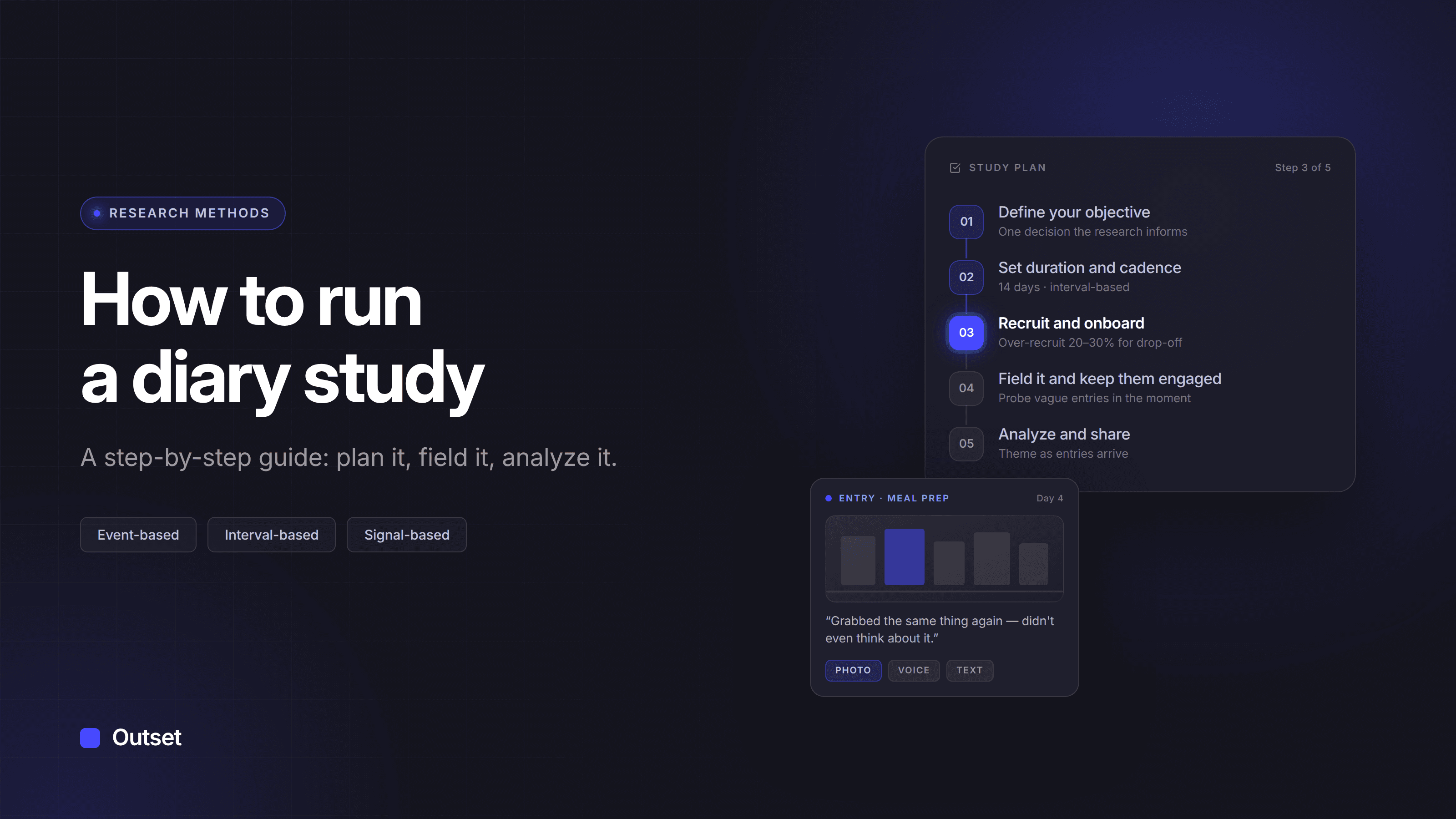
Diary studies and longitudinal research
Participants complete multiple interview sessions over time, capturing in-the-moment experiences. This approach reduces recall bias compared to retrospective interviews.
When not to use an AI moderated interview
AI moderated interviews aren't the right fit for every research question.
Highly sensitive or clinical conversations
Topics requiring trauma-informed moderation or clinical expertise still warrant human interviewers. Examples include grief research, mental health studies, or medical diagnosis discussions.
Executive and expert interviews
High-stakes B2B interviews with C-suite or industry experts may benefit from human rapport-building. AI moderated interviews work well for broader B2B audiences, but elite experts often expect human interaction.
Deep ethnographic fieldwork
In-context observation and immersive fieldwork require physical presence. AI moderated interviews complement but don't replace true ethnography.
How to write a discussion guide for an AI moderator
The quality of your AI moderated interview depends heavily on the discussion guide.
1. Anchor the guide to clear research objectives
Start with what you want to learn. Every question maps back to a research objective. Platforms like Outset auto-generate probing logic from your objectives, ensuring the AI pursues the threads that matter.
2. Write open-ended questions designed for probing
Avoid yes/no questions. Write questions that invite storytelling and elaboration. The AI probes on vague or incomplete answers, so design for depth from the start.
3. Add visual stimuli and screen sharing tasks
If you're testing concepts, prototypes, or packaging, include stimuli the AI moderator can reference. Outset's Visual Intelligence allows the moderator to see and probe on what participants show—not just what they say.
4. Mix quantitative and qualitative questions thoughtfully
Blend rating scales, ranking questions, or Likert items with open-ended follow-ups. This approach enables quant validation alongside qual depth in a single study.
5. Pilot the guide with synthetic and live participants
Test the discussion guide before full launch to catch confusing questions or logic errors. Outset offers synthetic user testing to pre-test guides before recruiting real participants.
Data quality and fraud detection in AI moderated interviews
Participant quality is a persistent concern in research. AI moderated interview platforms address this through automated fraud detection that monitors sessions in real time.
Quality signals typically include:
Response length and coherence: Flags participants who give one-word or nonsensical answers
Engagement patterns: Detects speeders who rush through without reading
Behavioral signals: Identifies copy-paste answers or bot-like patterns
Outset's AI-powered fraud detection achieves 99%+ accuracy in tagging low-quality responses. The platform maintains SOC 2 Type II, GDPR, and HIPAA compliance.
What to look for in an AI moderated interview platform
Not all platforms are built for professional research. Here's what separates tools built for the job from tools built for the demo.
Researcher configurability and control
The researcher controls the instrument—moderator style, probing depth, guide logic, analysis frameworks. Avoid platforms where the AI makes decisions you can't override.
Breadth of methodologies in one platform
Look for a platform that supports IDIs, concept testing, usability testing, diary studies, and UX evals in one place. Fragmented tools create operational overhead and data silos.
Visual Intelligence and behavioral signal capture
Can the AI moderator see screens, prototypes, packaging, or facial reactions? Visual Intelligence closes the say-do gap by probing on what participants show, not just what they say. Outset is first-to-market with the most robust Visual Intelligence capability.
Enterprise security and governance
Verify SOC 2 Type II, GDPR, and HIPAA compliance for sensitive data. Look for multi-layer governance, data-segregated workspaces, and audit controls for large organizations.
Human research and engineering partnership
A platform is only as good as the team behind it. With just 1% of companies reporting AI maturity, look for research experts who help design studies, build integrations, and drive adoption—not just self-serve software.
Running AI moderated interviews as an ongoing research program
Professional researchers don't run one-off studies—they run programs.
Governance and workspace controls
Enterprise teams need role-based permissions, data segregation, and audit trails. McKinsey reports only one-third of organizations have mature AI governance, making multi-layer governance essential for both small teams and 500-person organizations.
Integrations with recruiting and analytics tools
Outputs flow into existing systems—CRMs, research repositories, BI tools. Native integrations with recruiting panels reduce manual work and keep data connected.
Democratization across research and product teams
Enable non-researchers to run studies while maintaining methodological guardrails. Governance ensures quality and consistency even as usage scales across the organization.
Move from AI moderated interviews to decisions with Outset
Outset is the professional-grade platform for AI moderated research—built for the rigor, scale, and complexity that real research demands.
Four pillars make Outset different: Researcher Configurability (you control the instrument), Breadth of Capability (IDIs, concept testing, usability, diary studies, and UX evals in one platform), Enterprise Infrastructure (integrations, multi-layer governance, and democratization), and Human Partnership (research experts who design studies and drive adoption).
Trusted by enterprise teams at Microsoft, HubSpot, Away, Glassdoor, Nestle, WeightWatchers, and Hipcamp. SOC 2 Type II, GDPR, and HIPAA compliant. Over 500K+ interview hours, 10K+ studies, and access to 1.1B+ participants across 85+ countries.
Book a demo to see how Outset accelerates every step of research.
Frequently asked questions about AI moderated interviews
How long does a typical AI moderated interview take to complete?
Most AI moderated interviews take between 10 and 30 minutes for participants to complete, depending on the depth of the discussion guide. Researchers can adjust probing intensity to control session length.
Can AI moderated interviews be conducted by video?
Yes. AI moderated interviews can be conducted via video, voice, or text depending on the platform and research objectives. Video interviews capture facial expressions and visual reactions for richer behavioral data.
Are AI moderated interviews suitable for B2B research?
AI moderated interviews work well for B2B research, especially for reaching broad professional audiences at scale. For highly specialized executive or expert interviews, some teams still prefer human moderation.
How does the cost of AI moderated interviews compare to traditional moderated interviews?
AI moderated interviews typically cost less per interview than traditional human-moderated sessions because they eliminate moderator fees and scheduling overhead. The exact cost varies by platform and recruitment method.
Is participant data from AI moderated interviews secure and compliant?
Enterprise-grade platforms maintain SOC 2 Type II, GDPR, and HIPAA compliance to protect participant data. Look for platforms with data-segregated workspaces and audit controls for sensitive research.