How to run a diary study: a step-by-step guide
Jun 3, 2026
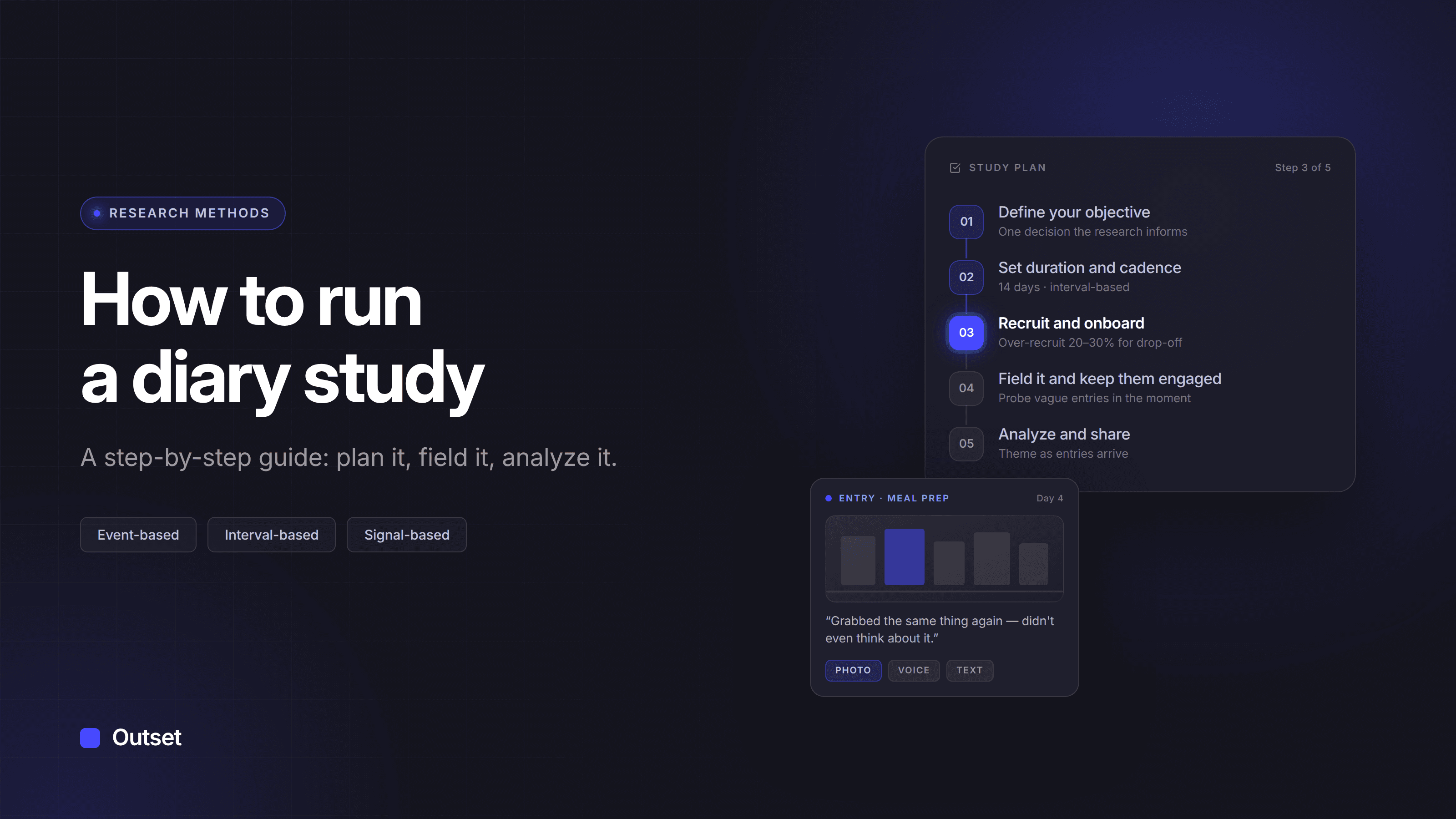
Learning how to run a diary study? This guide walks you through planning, executing, and analyzing a diary study from start to finish. Diary studies capture what people actually do — not what they remember doing.
What is a diary study?
A diary study is a qualitative research method where the same participants log their thoughts, actions, and experiences over time and in their natural environment. Unlike a one-time interview or survey, a diary study captures behavior in the moment it happens.
That real-time approach matters because people often misremember their own actions. A survey might ask, "How often did you use this feature last week?" A diary study asks, "What just happened?" — then records the answer while it's fresh.
There are three logging methods for gathering insights during diary studies: event-based, interval-based, and signal-based.
Event-based: participants log an entry each time a specific action or event occurs.
Interval-based: participants log entries on a set schedule, such as every evening or twice per day.
Signal-based: the study prompts participants at random or predetermined times to capture spontaneous moments.
Choosing the right method depends on what you're studying and how predictable the behavior is.
When to use a diary study
Diary studies work best when you need to understand behavior that changes over time, happens unpredictably, or takes place in settings you can't observe directly. They're also useful for private or sensitive topics where people behave differently when watched.
Use a diary study when you need to understand:
How users experience product onboarding over their first week or month
Daily routines and habits like morning rituals or meal prep
Long-term product use and satisfaction
Decision-making processes for high-consideration purchases
Customer journeys that span multiple touchpoints
For example, Outset ran a study with 120 US participants to capture how US households plan meals in their natural environment over time. That in-context approach revealed behaviors that a single survey or interview would have missed.
How to run a diary study, step by step
A diary study follows a clear sequence: define your objective, design the study structure, recruit participants, keep them engaged, then analyze findings. The sections below walk through each step.
Step 1: define your objective and research questions
Start with a single clear decision the research will inform. What will change based on what you learn?
Turn business questions into research questions. "Why aren't customers renewing?" becomes "What experiences lead customers to consider canceling?" Every diary prompt should trace back to that core question.
Before launch, pressure-test your assumptions. Keeping a study rigorous means confirming you're asking the right questions — not just asking questions correctly.
Key point: write out your research questions before designing any prompts. If a prompt doesn't connect to a stated goal, cut it.
Step 2: choose duration, cadence, and entry format
Match the study length to the behavior you're tracking.
Choose a few days when studying a single task or workflow
Choose 1–2 weeks when studying habits and routines
Choose a month or more when studying extended journeys like product adoption
Academic research on diary study duration confirms a minimum of two entries at two time points for any meaningful insight. Most applied research runs longer.
Next, pick a logging cadence. Event-based works for entries tied to a specific trigger. Interval-based works for daily or weekly check-ins. Signal-based works for spontaneous behavior.
Choose an entry format based on what you need: text, photo, video, or voice. Richer formats yield richer data, but they also increase participant effort.
Key point: longer studies capture more context, but they also raise the risk of participant drop-off. Balance depth against attrition.
Step 3: recruit and onboard participants
How many participants you need depends on your goals. Small UX studies often run 5–15 participants. For larger participant sample size in academic projects, NN/g suggests roughly 30–50 people.
Over-recruit by 20–30% to buffer against drop-off. Some participants will lose motivation, forget to log entries, or leave the study early.
When recruiting, ask yourself:
Does each candidate match your target profile and can they commit to the full study?
Can they access the required logging method (web browser, camera, etc.)?
Have you set clear expectations about the time involved?
When onboarding, confirm:
Did you provide a short orientation explaining the study's purpose?
Did you include an example entry showing what a good submission looks like?
Did you give participants a cheat sheet they can reference throughout the study?
Plan incentives tied to completion — partial payment for partial participation keeps participants motivated. If you need to reach participants across markets, you can run studies in 40+ languages.
Step 4: run the study and keep participants engaged
Once the study starts, check entries as they arrive. Daily review beats a single end-of-study review.
Send reminders based on the cadence you set. Participants forget, especially in longer studies. Automated reminders help.
Follow up on vague or interesting entries while they're fresh. The old approach queues follow-ups for later, but context fades fast. In-the-moment probing yields deeper answers.
In an Outset study of 98 US participants, dynamic follow-up questions drove a 3.5x increase in total response volume. Probing in the moment captures detail that a "tell me more" days later cannot.
Key point: watch for signs of fatigue — shorter entries, missed logs, or declining quality. Reach out to participants who go quiet.
Step 5: analyze and share your findings
Diary studies generate a lot of data. Dozens of participants, multiple entries per participant, and rich media add up fast.
Tag and theme entries as they arrive. Waiting until the study closes creates an overwhelming backlog. Round-by-round analysis spreads the work and surfaces early patterns.
Look for:
Patterns that repeat across participants
Changes over time within a single participant
Outliers that challenge assumptions
Representative quotes and clips for stakeholder presentations
Consider a wrap-up interview with a subset of participants. A short debrief lets you fill in gaps and test your interpretation of what you saw.
Share findings with stakeholders through themes and highlights, not raw data. Three to five key insights with supporting quotes land better than a 50-page transcript dump.
Benefits and limitations of diary studies
Every method has trade-offs. Diary studies capture real behavior over time, but they require more effort from participants and researchers alike.
Benefits | Limitations |
|---|---|
Captures real behavior in context, not recalled behavior | Participant fatigue can lead to drop-off |
Reduces observer bias — participants act naturally | Relies on self-report, which has gaps |
Reveals changes and patterns over time | Generates high data volume |
Works for sensitive or private topics | Requires more setup and logistics |
Two of the biggest limitations — thin entries and analysis overload — shrink when you probe in the moment and synthesize per session.
Running diary studies with Outset
Outset approaches diary studies differently. Every round is a live AI-moderated conversation, not a static form. The AI catches vague answers and asks follow-up questions within the same session, so participants clarify their thinking before they move on.
Every session auto-generates an AI summary the moment it closes. Analysis starts at round one, not after the final submission.
For teams already using Outset for IDIs, concept tests, or usability studies, diary runs in the same platform. No new contracts, no context switching. Native cohort tracking, round scheduling, automated invites, and reminders are built in.
Recruit from Prolific, Respondent, or your own connected panels. Outset's V1 diary studies are web-based, so participants complete sessions through their browser.
Outset is trusted by teams at Microsoft, Nestlé, WeightWatchers, and others. The platform has powered 500K+ interview hours across 10K+ studies in 85+ countries. SOC 2 Type II, GDPR, and HIPAA compliant.
Frequently asked questions
What is the diary study method?
The diary study method is a longitudinal qualitative approach where participants record experiences over time, capturing real behavior in context rather than recalled behavior.
How do you structure a diary entry?
A diary entry includes a prompt tied to a research question, space for what happened and how the participant felt, and an option to attach a photo, video, or voice note.
What is the difference between a diary study and a survey?
A survey captures recalled behavior at a single point in time. A diary study captures behavior in the moment it happens, repeated over days or weeks.
How many participants do you need for a diary study?
Small UX studies often run 5–15 participants. Larger or academic projects aiming for generalizable findings may include 30–50 participants or more.
How long should a diary study last?
Duration depends on the behavior you're studying — from a few days for short tasks to a month or more for extended journeys. Balance depth against the risk of participant drop-off.