Business
Digital Intelligence: What Clicks Reveal
—

Aaron Cannon
Every UX researcher knows the trade-off.
Moderated sessions give you behavioral context and real-time follow-up. You can watch where someone hesitates, pivot your questions on the spot, and capture the moment of confusion before the participant rationalizes it away. But you can only run so many.
Unmoderated async testing scales. But it captures behavior without understanding it.
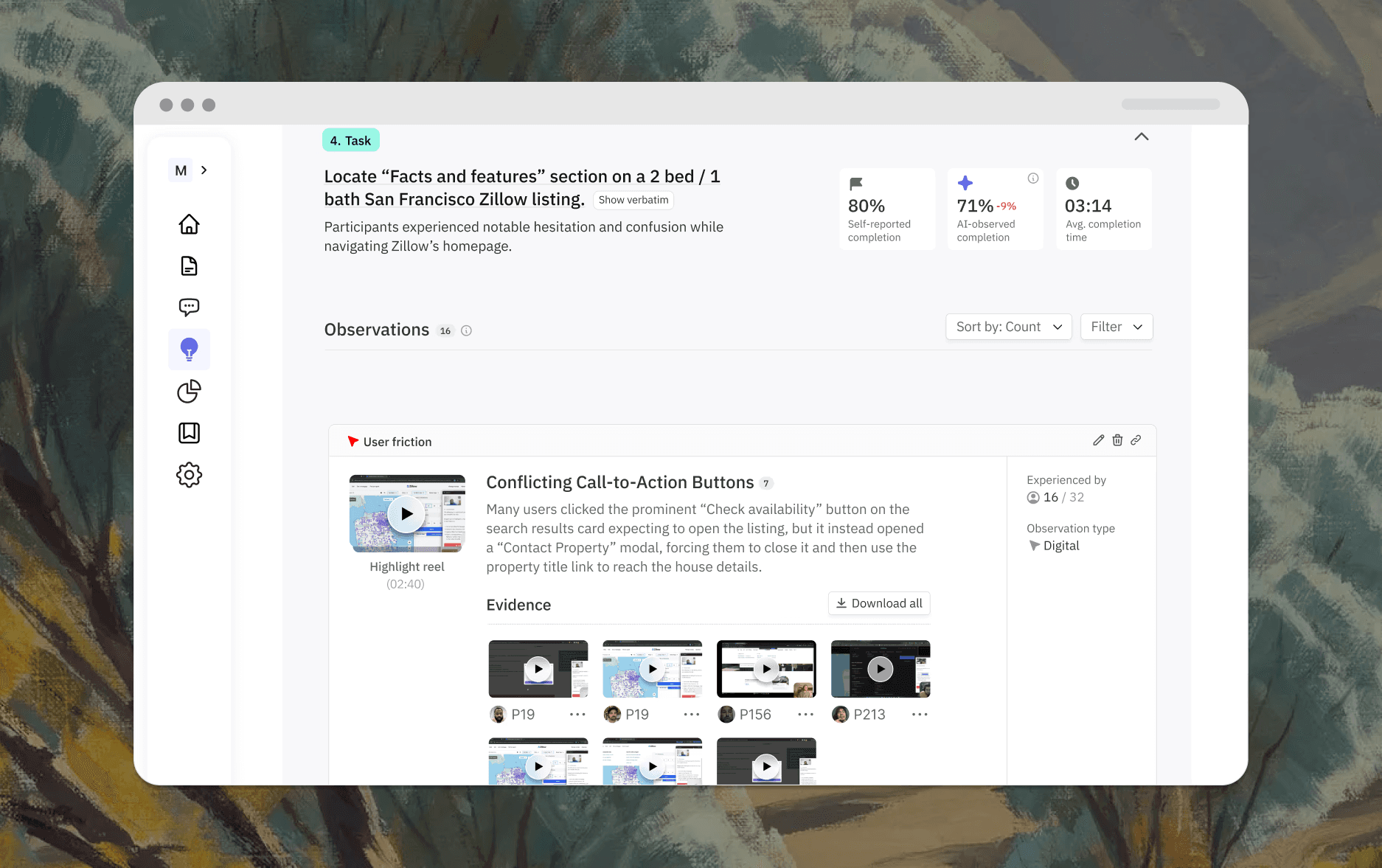
Digital Intelligence changes that. During a session, Outset Agent observes what participants do on screen at key moments and probes based on what it actually saw — not from a pre-written script, not after a researcher reviews the recording. While the moment is still live.
Aaron Canon and John Whalen cover the full Visual Intelligence suite, including a live demo of Digital Intelligence, in a recent episode of AI 4 UX.
Listen on your favorite podcast app: Apple Podcasts | Spotify | YouTube | iHeart
For UX Researchers
The thing that makes usability research hard at scale isn't the sessions. It's what happens after.
Run 50 unmoderated sessions and you have 50 videos to review — hunting for the hesitation on step 3, the backtrack before checkout, the moment a participant gave up and why. That's not a research problem. That's a labor problem.
And even if you watch every video, you're working backward. The session already happened. The participant already rationalized what they did. The tool that recorded it had no idea what it was seeing and no way to ask.
Digital Intelligence works differently. The agent watches screen behavior during each task and probes based on what it actually saw — while the moment is still live. A participant hesitates on a critical field? It asks about that specific moment before they move on. A participant rage-clicks through a flow and gives up? It catches it in real time and follows up, not because a researcher flagged it, but because the AI observed it.
No video review queue. No reconstructing what happened from a recording. The probe comes from behavior, not a script.
The synthesis layer fuses what participants said with what they did. Researchers have the behavioral record in front of them when analysis starts, not just what participants chose to report. The interpretation is still yours. The raw material is better.
For Market Researchers
Market research is moving into digital contexts fast: concept testing on landing pages, packaging evaluation on product detail pages, ad testing with live stimulus. In those settings, what someone clicks before they answer matters as much as the answer itself. Digital Intelligence captures both in the same session, without bolting on a separate behavioral tool.
What This Looks Like Across Industries
Healthcare. Patient portal usability, health app navigation, EHR flows. Patients often report understanding health information while struggling with basic tasks. Digital Intelligence captures where they stop or backtrack before they've had time to rationalize it.
CPG. E-commerce product pages, digital concept testing, virtual shelf research. Click patterns and dwell time on a product page reveal purchase consideration that participants rarely articulate unprompted.
Retail. Checkout optimization, loyalty program UX, app navigation. Behavioral analytics tell you where drop-off happens. Digital Intelligence tells you why.
Financial services. Onboarding flows, complex product pages, trading platforms. Claimed comprehension is common. Demonstrated comprehension is rarer. Hesitation and backtracking surface confusion before it becomes a support ticket.
The Difference This Makes
Unmoderated testing at scale solved the volume problem. What's been missing is a system that sees what's happening in real time and responds to it, without a researcher in the room and without a video review queue afterward.
Digital Intelligence closes that gap. Every session, at any scale.
Interested in learning more? Book a personalized demo today!
Book Demo
About the author
Aaron Cannon
CEO - Outset
Aaron is the co-founder and CEO of Outset, where he’s leading the development of the world’s first agent-led research platform powered by AI-moderated interviews. He brings over a decade of experience in product strategy and leadership from roles at Tesla, Triplebyte, and Deloitte, with a passion for building tools that bridge design, business, and user research. Aaron studied economics and entrepreneurial leadership at Tufts University and continues to mentor young innovators.