Business
AI Made Research Accessible. Here's How to Make Sure It Stays Rigorous.
—

Aaron Cannon
AI tools have made it remarkably easy for non-researchers to spin up studies and get answers fast. That's good news, but speed without structure creates a specific kind of risk: research that looks convincing but is built on a broken foundation. Wrong questions, wrong participants, and no decision framing means the findings land, decisions get made, but nobody realizes the whole thing was flawed until it's too late.
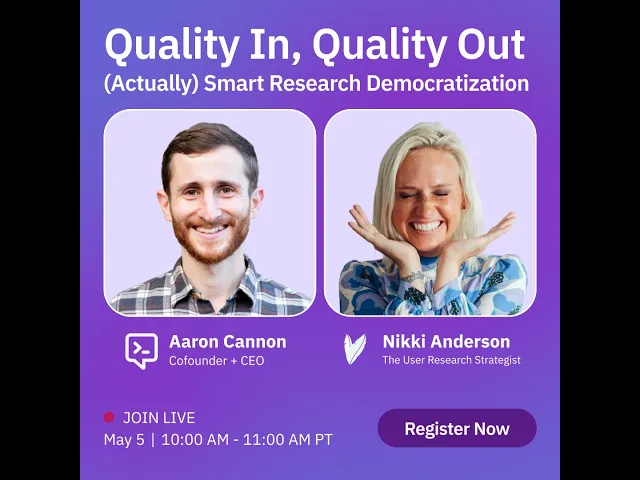
We sat down with The UX Research Strategist’s Nikki Anderson to break down where research foundations most commonly crack with democratization, and how AI-moderated research, when done right, can be the infrastructure that holds it all together.
What AI-Moderated Research Actually Is
For the unfamiliar, AI-moderated research uses an AI moderator to conduct qualitative sessions (interviews, concept tests, usability studies) at a scale no human team could match. Outset’s AI moderator follows a structured guide with consistency, probes on follow-ups, synthesizes results, and now uses Visual Intelligence to close the say-do gap. It can spot when a participant rage-clicks through a task and then calls it easy, and follow up on that gap in real time. That consistency is what makes AI moderation a natural fit for democratized research. But the moderator is only as good as what you feed it.
Where Research Breaks Before It Starts
Nikki sees research break in the same three places over and over:
The Objective: Framed as a business question, not a research question (e.g. "fix the drop-off" rather than "understand the behavior").
The Guide: Built to confirm, not to learn (e.g. loaded with leading and preference-based questions that nudge participants toward telling you what you want to hear).
The Study: Launches before anyone pressure-tests the assumptions baked into the brief (e.g. the feature is treated as fine, and the users are treated as the problem).
She shared a brutal example: a travel company spent months building a credit card scanner to reduce booking drop-off, but the drop off rate never changed. They were in Germany…Germans don't photograph their credit cards. In AI-moderated research, these foundation problems compound even faster. A flawed guide executed at scale doesn't just waste one session. It wastes hundreds.
The Five-Question Pre-Study Checklist
Nikki uses this checklist with every democratization program she builds. It works whether you're a researcher reviewing an incoming brief or a PWDR (person who does research) setting up a study in a tool like Outset:
What decision will this research inform? Specific, not vague. Nikki recommends a fill-in-the-blank: "This will help us decide [decision] in order to [action] so that we can [result]." If you can't fill that in, don't run the study.
Is this a research question or a business question? Business questions are fine as a starting point, they just need reframing. "Do new users find onboarding helpful?" becomes "How do new users build confidence in the platform in their first 30 days?"
Who am I talking to, and why specifically them? Vague recruitment leads to wasted sessions. Nikki learned this one the hard way: she once forgot to screen for people who had personally planned travel. Participants showed up and said their partner had handled it. Ninety minutes with nothing to talk about.
Does every question in my guide serve a stated goal? Every question should trace back to a research objective. In AI-moderated sessions where the moderator follows the guide closely, extra questions aren't just clutter, they're participant bandwidth wasted with every single participant.
Have I pressure-tested my assumptions? Call out what you already believe, then include questions that could prove you wrong.
This is exactly the kind of thinking our AI study-building guide is designed to prompt. Rather than dropping PWDRs into a blank question editor, it asks what they're trying to learn, who they're talking to, and what methodology fits. It's a Socratic approach: a checklist come to life.
What Smart Democratization Looks Like in Practice
There are really two versions of democratization:
Chaotic: no templates, no standards, no review. PWDRs running studies they don't understand, with the research team stuck doing damage control.
Intelligent: shared structure, review checkpoints, with researchers focused on judgment rather than triage.
As Nikki put it: "I could either push democratization away and people will go and do it anyway, or I could shape this."
AI-moderated research is what makes shaping it possible at scale. When the research team can't be in the room for every session, they can set up the AI moderator as the arbiter of consistency. That's what our PWDR tools are built for:
Approval flows let researchers review and sign off on a study before it goes live. Some are quality gates, some are financial, so a PM can't accidentally launch a $20,000 recruitment panel without oversight.
Custom AI moderators are trained by the research team and deployed org-wide. Different moderators can be configured for different use cases, so every PWDR gets a consistent, high-quality interview experience without building one from scratch.
Org-wide context libraries inject strategic business context into the AI system, so the moderator understands the landscape a PWDR might not carry in their head.
The most effective democratization programs we've seen have active feedback loops. PWDRs share what worked and what didn't after each study. Researchers review and refine. The training effect compounds, and the whole org gets better at research over time.
For any researchers reading who are still uneasy about this: when you own the guardrails, the moderator configurations, and the approval flows, you're still in control. You're building the infrastructure that makes insight-driven decisions possible across the entire organization. We've sold to hundreds of companies, large and small, and none of them have cut researchers because of AI. The appetite for research is growing and lower costs encourage more demand, not less.
About the author
Aaron Cannon
CEO - Outset
Aaron is the co-founder and CEO of Outset, where he’s leading the development of the world’s first agent-led research platform powered by AI-moderated interviews. He brings over a decade of experience in product strategy and leadership from roles at Tesla, Triplebyte, and Deloitte, with a passion for building tools that bridge design, business, and user research. Aaron studied economics and entrepreneurial leadership at Tufts University and continues to mentor young innovators.
Interested in learning more? Book a personalized demo today!
Book Demo